Episode 21 - The Clodhoppers Take Trenton
Episode 21 covers the desperate winter of 1776, Washington's crossing of the Delaware River on Christmas night, and the surprise victory at Trenton. After months of retreat and defeat, two quick victories at Trenton and Princeton transformed American morale and kept the Continental Army alive. Students will understand why this moment is considered the turning point of the Revolution's darkest hour.
Key Takeaways
By December 1776, Washington's army had shrunk from 19,000 men to roughly 6,000, many of them barefoot and unpaid.
The Hessians at Trenton were German mercenaries hired by Britain. They weren't drunk on Christmas, as the legend suggests. They were exhausted from days of alert.
The battle lasted only 45 minutes. Washington's forces captured 900 Hessians and suffered five wounded and no deaths in combat.
Thomas Paine wrote 'The Crisis' that December, and Washington read it aloud to his troops before the crossing.
The follow-up victory at Princeton on January 3, 1777 was just as important. Two wins in eight days reversed a months-long collapse in morale and recruitment.
Sign up here to be the first to know about new History250 releases, content & resources!
FAQ - Frequently Asked Questions
Q1: Were the Hessians drunk when Washington attacked at Trenton?
The drunk Hessian story is a popular myth. Colonel Rall's garrison had been on high alert for days before the attack and had repelled a smaller American raid just days earlier. They were exhausted, and the storm that night made a surprise attack seem unlikely. But there's no credible contemporary evidence that they were drunk. The speed and coordination of Washington's attack, not Hessian intoxication, explains the outcome.
Q2: How did Washington get 2,400 men, horses, and cannons across the Delaware River in a storm?
He used a fleet of Durham boats, large flat-bottomed cargo vessels that local boatmen from Marblehead, Massachusetts had been operating for Washington's army since the evacuation of Brooklyn. The crossing took most of the night and was genuinely dangerous. Ice floes in the river could have swamped the boats. Two smaller crossing attempts by supporting columns failed entirely due to the weather, leaving Washington's main column to attack alone.
Q3: Who were the Hessians and why was Britain using German soldiers?
Hessians were German soldiers hired from several German states, primarily Hesse-Cassel, to fight for Britain. Britain's regular army wasn't large enough to suppress a full-scale colonial rebellion, and Parliament was reluctant to dramatically expand it. Hiring German troops was faster and politically easier. About 30,000 German soldiers served in the war. Many stayed in America after the war ended.
Q4: Why did Washington need a victory so urgently in December 1776?
Most Continental Army enlistments expired on December 31, 1776. Without a victory to show, there was little hope of convincing men to re-enlist or new recruits to sign up. Congress had nearly abandoned Philadelphia out of fear the British would take the city. A loss or continued stalemate that winter likely would have ended organized military resistance to British rule.
Q5: What was the Battle of Long Island and why did it matter?
The Battle of Long Island, also called the Battle of Brooklyn, was fought on August 27, 1776. It was the largest battle of the Revolutionary War in terms of troop numbers. Howe's forces outmaneuvered Washington and inflicted 2,000 casualties. Washington's retreat across the East River saved his army from capture, but the loss effectively ended American control of New York City for the rest of the war.
New York Falls, the Army Retreats
By September 16th, 1776, the British had taken New York City. Three days later, a devastating fire destroyed much of the city's west side. By December, General George Washington and what remained of his army had retreated into New Jersey. That same month, out of fear that the British would soon take Philadelphia, the Continental Congress moved their deliberations to Baltimore. American patriots were in dire straits. British commander William Howe thought the whole war would soon be over. By July 1776, General Washington had an army of 19,000 men in position at New York City. British commander William Howe marshaled a formidable army of 32,000 men. Eight thousand of them were German mercenaries, the largest group of which were from Hesse-Kassel. The Americans called them Hessians. On August 27th, the two forces confronted each other in the Battle of Brooklyn, also known as the Battle of Long Island. In the most defining maneuver of the day, 20,000 British troops moved around Washington's eastern flank. Patriots suffered 2,000 casualties. The British only several hundred.
The loss was great, but Washington did not surrender. He retreated to the edge of the East River, then under the cover of night and amidst a providential fog, sailed across the river to Manhattan. On September 21st, Connecticut Captain Nathan Hale was captured by the British and executed as a spy. Before hanging the 21-year-old patriot, the British asked if he had any last words, to which Hale replied, "I only regret that I have but one life to lose for my country." Just months earlier the colonies had formally broken from Britain, as we cover in our episode on the Declaration of Independence.
The Game Will Be Pretty Well Up
On November 16th, American troops mounted a final defense of New York at Fort Washington, an earthen fortification on the north end of Manhattan. General Washington observed the battle from across the Hudson River. To his dismay, the British, who outnumbered the Americans more than two to one, routed the Patriot forces and took over 2,000 prisoners of war. Almost all of them would die in captivity.
Washington and his remaining forces retreated south through New Jersey, pursued by British General Lord Cornwallis. Halfway across the state, the British halted their pursuit. The American forces carried on into Pennsylvania, but they were cold and exhausted, their morale declining. By the year's end, most of the army's enlistments would expire. Most of the men would likely return to their families. On December 16th, Washington wrote to his brother that if there was no significant change in their fortunes, "the game will be pretty well up." Then came the game changer. Undaunted, Washington planned to cross the Delaware River and mount a surprise attack on the Hessian garrison at Trenton. A larger turning point would come the following autumn, the subject of our episode on the Battle of Saratoga and the French alliance.
Those Clodhoppers Will Not Attack Us
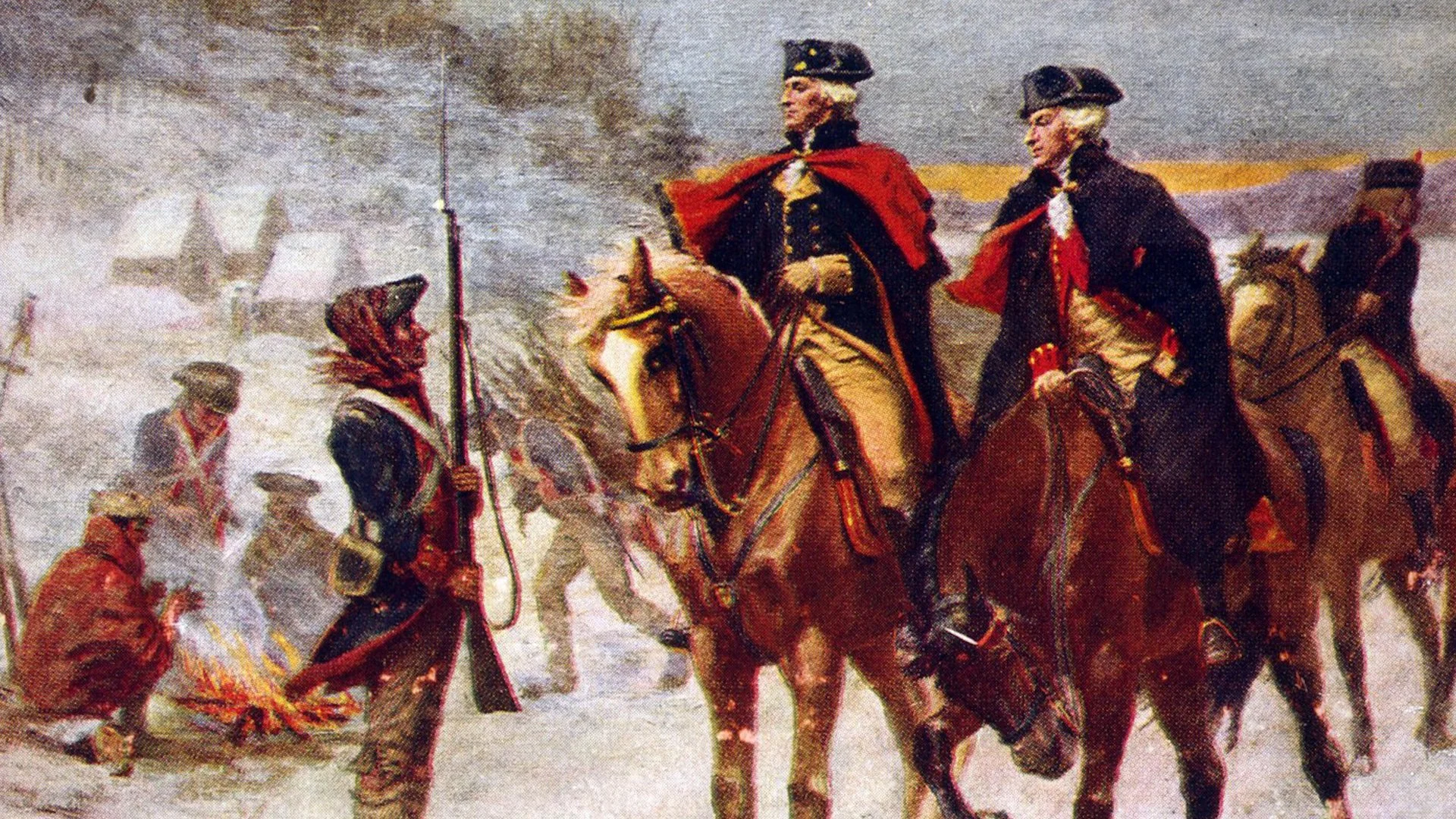
It was Christmas night, December 25th, 1776. A winter storm hit the area just as Washington and his troops crossed the river. The wind was stiff, the snow deepening by the hour. Hessian Colonel Rall dismissed any concerns about the Americans. "Those clodhoppers," he insisted, "will not attack us." Washington's plan had called for three crossing points, but two of them were choked with ice. His group alone, about 2,400 troops, made it across the river and commenced the nine-mile march to Trenton. Henry Knox ferried 16 cannons across the Delaware and moved them toward the Hessians. At 8:00 in the morning, Washington launched his surprise attack.
Colonel Rall positioned his men in the center of town, replete with cannon fire of their own, but Knox and his men fired on the Hessians and drove them back. Rall attempted a counterattack, but the Americans had the German forces surrounded. As the Hessians tried to defend against Washington's advancing troops, musket fire burst forth from the nearby houses. Rall and 22 other Hessian soldiers were killed. Washington and his men took 896 prisoners of war. They suffered only a handful of casualties.
Princeton and a Turning Tide
Emboldened, Washington would cross the Delaware twice more. Just after the new year, he won the Battle of Princeton. Washington had surprised everyone, especially the Hessians and British commander Howe. His bold strategy led to victories at Trenton and Princeton. In the army and among the patriot public, confidence in the commander of the Continental Army soared.
With General Washington in command, Americans now knew that they could win the war. George Washington had become America's first national hero. Thomas Paine captured the mood in his tract "The Crisis," written that December: "These are the times that try men's souls. The summer soldier and the sunshine patriot will, in this crisis, shrink from the service of their country; but he that stands it now, deserves the love and thanks of man and woman." Within a year, Washington's army would face its hardest winter, the subject of our episode on Valley Forge and Baron von Steuben.