
Documents
Original documents are central to what historians examine as part of understanding the past. Our team is building out a catalog of easily accessible historical documents that teachers and students can study. Starting with documents related to the four expeditions to the New World led by Columbus, we are creating a timeline in documents all the way up to recent events.
Please report broken or missing links here.
Chronology of Events in Documents:
1492 Privileges and Prerogatives Granted by their Catholic Majesties, Isabella and Ferdinand, to Christopher Columbus.
1492 Excerpts from the journal of Christopher Columbus.
1493/4 Letter from Columbus to King and Queen of Spain, translated, reports on the success of his voyage.
1494 Treaty of Tordesillas, dividing North and South America by Spain and Portugal.
1606 Virginia Charter granted by King James.
1607 Instructions from the Virgina Company of London to the captains and company of Jamestown.
1606-24 Jamestown events recounted in John Smith’s history.
1610 Laws for the Colony of Virginia.
1620 Mayflower Compact.
1622 A Jamestown settler describes life in Virginia.
1629 Salem Covenant.
1630 John Winthrop, “A Modell of Christian Charity,” preached en route to the Massachusetts Bay Colony.
1636 The Enlarged Salem Covenant.
1640 The sentencing of John Punch, from the Minutes of the Council and General Court of Colonial Virginia (pg. 466)
1647 Old Deluder Satan Act for public schools in Massachusetts.
1649 Maryland Act of Religious Toleration.
1662 Laws of Virginia, Act XII: “Negro womens children to serve according to the condition of the mother.”
1663 Rhode Island Royal Charter.
1667 Laws of Virginia, Act III: “An act declaring that baptisme of slaves doth not exempt them from bondage.”
1682 William Penn, An Act for Freedom of Conscience.
1693 Cotton Mather, account of Salem Witch Trial.
1700 The publication of The Selling of Joseph, the first anti-slavery text in America.
1704 Act to Prevent the Growth of Popery in Maryland.
1753 Virginia Governor Dinwiddie letter demanding French removal from Ohio River Valley, delivered by Major George Washington.
1756 Act to Prevent the Growth of Popery in Maryland.
1763 Treaty of Paris, finalizing expanded British control in North America.
1763 Proclamation from King George III prohibiting American colonists from settling in the lands west of the Appalachians.
1764 The Sugar Act, a tax on sugar imported into the American colonies.
1765 The Stamp Act, the first direct tax on the American colonies issued by the Parliament in Great Britain.
1765 The Quartering Act, the first of two issued to the American colonies.
1765 The Stamp Act Congress met in New York in October of 1765 and published the Resolutions of the Stamp Act Congress.
1766 An Act Repealing the Stamp Act and The Declaratory Act are passed on the same day.
1767 Letter from Benjamin Franklin to Lord Kames on the topic of the tension between Britain and the colonies.
1767 Parliament issues a series of laws known as The Townshend Acts.
1767-68 John Dickinson’s letters arguing against the Townshend Acts published as “Letters from a Farmer in Pennsylvania to the Inhabitants of the British Colonies”.
1768 Massachusetts issued a Circular Letter to the other Colonial Legislatures in response to the Townshend Acts.
1773 The Tea Act passed by British Parliament.
1774 The Coercive, or Intolerable Acts: The Boston Port Act, The Massachusetts Government Act, The Administration of Justice Act, and The Quartering Act.
1774 Thomas Jefferson’s A Summary View of the Rights of British America.
1774-1789 The Journals of the Continental Congress, Selected Documents.
1775 Edmund Burke’s Speech on Conciliation with the Colonies.
1775 (1798) Letter from Paul Revere written in 1798 recounting his 1775 ride.
1775 George Washington’s Address to the Continental Congress upon his appointment as Commander of the Continental Army.
1775 Letter from patriot John Waller regarding Battle of Bunker Hill.
1776 Maryland Constitution ratified, Declaration of Rights XXXIII restores religious freedom to all Christians, including Catholics.
1776 Thomas Paine’s Common Sense.
1776 Virginia Declaration of Rights, written by George Mason and adopted by Virginia in June 1776.
1776 Thomas Jefferson’s original draft of the Declaration of Independence.
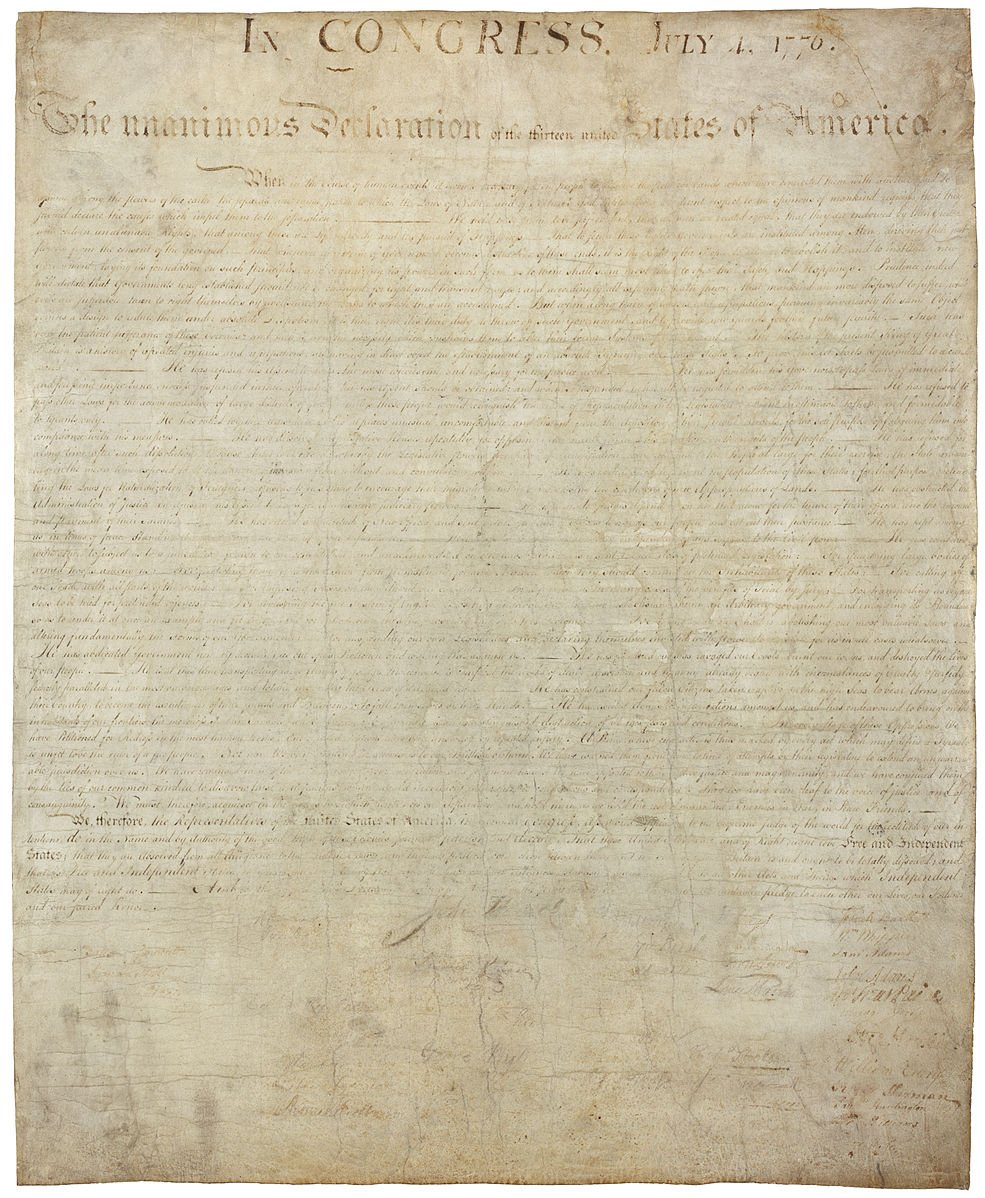
1776 Text of The Declaration of Independence; the original signatures.
1776 Henry Knox letter to his wife Lucy concerning the Battle of Trenton.
1777 The Articles of Confederation adopted by the Continental Congress in November.
1778 Von Steuben Blue Book with military rules and regulations (published 1779).
1781 Washington’s letter to Cornwallis detailing terms of surrender.
1787 Constitutional Convention: James Madison’s Notes of Debates in the Federal Convention, Jonathan Elliot’s Debates in the Several State Conventions on the Adoption of the Federal Constitution (or collection of both Elliot and Madison’s notes), Farrand’s Records of the Federal Convention of 1787 (published in 1911), James Madison’s Virginia Plan, and William Paterson’s New Jersey Plan.
1787 The Federalist Papers, and the Antifederalist Papers.
1787-88 Ratified Constitution of the United States transcription; Heritage Foundation’s Guide to the Constitution.
1791 The Bill of Rights transcription.
1793-94 Washington’s Proclamation of Neutrality; Pacificus & Helvidius Letters—Hamilton’s defense of the Proclamation and Madison’s responses.
1794 The Jay Treaty between Britain and the United States.
1795-96 The Treaty of San Lorenzo with Spain (“Pinckney’s Treaty”) that resolved navigation disputes and established southern boundary of the US.
1796 Washington’s Farewell Address, published as a letter on September 17.
1798 The Alien and Sedition Acts
1800 Convention of 1800 between France and America, also known as The Treaty of Mortefontaine.
1800 The Treaty of San Ildefonso transcription, Spain officially transferred the Louisiana territory back to France.
1800 Tally of Electoral Votes for the 1800 Presidential Election.
1800 Letter from Alexander Hamilton, Concerning the Public Conduct and Character of John Adams, Esq. President of the United States.
1801 Jefferson’s First Inaugural Address.
1803 Jefferson's Secret Message to Congress Regarding the Lewis & Clark Expedition, asking for $2,500 in funding.
1803 Marbury v. Madison decision, a landmark case in the history of judicial review.
1803 Louisiana Purchase Treaty, by which the United States purchased 828,000 square miles of land west of the Mississippi River for $15 million from France.
1803 Meriweather Lewis’ Packing List for the expedition to the West.
1803-1806 Journals of the Lewis and Clark Expedition.
1804 Amendment XII, providing the procedure for electing the president and vice president.
1807 An Act Prohibiting the Importation of Slaves.
1809 The “Treaty of Fort Wayne,” requiring native tribes to sell some three million acres of land in Midwestern America to the federal government.
1812 Special Message to Congress on the Foreign Policy Crisis, a speech delivered by James Madison in which he asks Congress to declare war against Great Britain.
1812 An Act Declaring War Between the United Kingdom of Great Britain and Ireland and the Dependencies Thereof and the United States of America and Their Territories, marking the official start of the War of 1812.
1814 The Treaty of Ghent, ending the War of 1812.
1815 “Like a Sea of Blood,” A Kentucky Soldier’s Account of the Battle of New Orleans.
1819 Treaty of Amity, Settlement, and Limits Between the United States of America and His Catholic Majesty also known as the “Adams-Onís Treaty.” Spain ceded Florida to the United States. Signed in 1819, ratified and went into effect in 1821.
1819 The Application of Missouri for Admission to the Union.
1820 The Missouri Compromise, legislation that admitted Missouri as a slave state and Maine as a non-slave state at the same time.
1823 The Monroe Doctrine, articulated during President Monroe's seventh annual message to Congress.
1824 The Constitution of United Mexican States, ratified after Mexico’s independence from Spain.
1824 Tally of the 1824 Electoral College Vote.
1828 Tariff Act, also known as the “Tariff of Abominations."
1830 The Indian Removal Act, which authorized the President to negotiate removal treaties with Indian tribes living east of the Mississippi River.
1830 President Andrew Jackson's Message to Congress ‘On Indian Removal.’
1832 “No. 1 - Something New” written by Samuel W. Dexter in Page 2 of Ann Arbor’s The Emigrant. Here Dexter envisioned a railroad uniting the Eastern and Western shores of the United States.
1832 Worcester v. State of Georgia Supreme Court decision, Written by Chief Justice John Marshall, the Court held that the state of Georgia had no jurisdiction over Cherokee land.
1832 The Tariff Act of 1832, which slightly lowered rates from the controversial 1828 "Tariff of Abominations."
1832 South Carolina Ordinance of Nullification, in which the state of South Carolina declared that it would treat the federal Tariff Acts of 1828 and 1832 as null and void.
1833 Force Bill, in which President Andrew Jackson declared that states did not have the right of nullification, as South Carolina had claimed, and asked Congress for authority to collect the tariff by force if necessary.
1834 “Book of Sports,” by Robin Carver.
1835 Transcript of the Treaty of New Echota.
1835 Declaration of the People of Texas.
1836 William Barret Travis' Letter from the Alamo, dated February 24, 1836.
1836 Texas Declaration of Independence from Mexico.
1836 The Treaty of Velasco, formally ending the Texas Revolution.
1839-1851 Laws of the Cherokee Nation, a written constitution.
1840 Lyrics to “Tippecanoe and Tyler Too,” the campaign song of Whig candidate, William Henry Harrison.
1845 John O’Sullivan’s “Annexation” from the United States Magazine and Democratic Review.
1845 The ‘Knickerbocker Rules’ drafted by Alexander Cartwright and William Wheaton, which formalized the rules of the modern concept of baseball and were applied at the first official game at Elysian fields.
1846 President Polk’s speech: Announcement of War with Mexico.
1846 Treaty with Great Britain, in Regard to Limits Westward of the Rocky Mountains, also known as the Oregon Treaty.
1847 An overview of Congressman Abraham Lincoln’s ‘Spot Resolutions,’ with primary documents.
1848 The Treaty of Guadalupe Hidalgo, formally ending the Mexican-American War.
1848 National American Woman Suffrage Association full document from “The first convention ever called to discuss the civil and political rights of women,” including the Declaration of Sentiments.
1848 President James K. Polk’s Fourth Annual Message to Congress, confirming the discovery of gold in California.
1849 A Project for a Railroad to the Pacific by Asa Whitney.
1851 Maryland Constitution, Article 33, secures religious liberty for Jews and non-Christians.
1854 "An Act to Organize the Territories of Nebraska and Kansas," more popularly known as the Kansas-Nebraska Act, which repealed the Missouri Compromise.
1854 Abraham Lincoln’s Peoria Speech, which criticized popular sovereignty and the Kansas-Nebraska Act, and thrust him back into the political landscape. Delivered on October 16, 1854.
1857 The “Laws of Baseball,” also known as Baseball’s ‘Magna Carta’ proposed at the ‘Convention for Baseball’ sponsored by the Knickerbocker Baseball club (primary source).
1857 Dred Scott v. Sanford decision, this Supreme Court ruling stated that enslaved people were not citizens of the United States and, therefore, could not expect any protection from the federal government or the courts.
1858 The Lecompton Constitution primary document and excerpt on slavery in the Kansas Territory (transcript).
1858 Abraham Lincoln’s House Divided Speech.
1858 Letter from Stephen Douglas to Abraham Lincoln setting the places and dates for the Lincoln-Douglas debates.
1858 Transcripts of the first, (Ottawa, Illinois). second (Freeport, Illinois), third (Jonesboro, Illinois), fourth (Charleston, Illinois), fifth (Galesburg, Illinois), sixth (Quincy, Illinois), and seventh (Alton, Illinois) Lincoln-Douglas debates.
1859 John Brown’s Final Speech and Last Note.
1860 A bill for the admission of the State of Kansas into the Union.
1860 Senate Roll Call for the attempted override of President Buchanan's veto of the Homestead Act of 1860 (S. 416). Buchanan vetoed the proposed Homestead Act in 1860 but the Senate did not have enough votes to overturn his decision. President Lincoln would sign the act into law two years later.
1861 The Fort Sumter Correspondence between the South Carolina authorities and Major Robert Anderson and the Federal Government, relative to Fort Sumter.
1861 First Inaugural Address of President Abraham Lincoln.
1861 Letter from President Lincoln to South Carolina Governor Francis Pickens.
1861 Proclamation on State Militia (Abraham Lincoln, Monday, April 15, 1861).
1862 The Homestead Act of 1862, which granted adult heads of families 160 acres of surveyed public land in the Western territories.
1862 Special Order No. 191; the movement order from Robert E. Lee to his men in the Maryland Campaign, discovered by Union troops: (transcript and primary document).
1862 The Pacific Railway Act (transcript and primary document), officially titled: An Act to Aid in the Construction of a Railroad and Telegraph Line from the Missouri River to the Pacific Ocean, and to Secure to the Government the Use of the Same for Postal, Military, and Other Purposes.
1862-1864 Confederate Conscription Acts of 1862-1864, a series of measures taken by the Confederate government to procure the manpower needed to fight the American Civil War.
1863 The Emancipation Proclamation (transcript and primary document).
1863 Homestead Application No. 1, written by Daniel Freeman.
1863 The Gettysburg Address delivered on the battlefield near Gettysburg, Pennsylvania.
1863 The London Football Association’s Rules for Association football, the rules used in the first college football game on Nov. 6, 1869.
1863 Abraham Lincoln’s Proclamation of Amnesty and Reconstruction (transcript and primary document).
1864 Letter from Jefferson Davis to Confederate General Lee to relieve General Joseph E. Johnston.

1864 Telegram from General William T. Sherman to President Abraham Lincoln announcing the surrender of Savannah, Georgia, as a Christmas present to the President.
1865 Amendment XIII, the abolition of slavery.
1865 Special Field Order No. 15 or “Forty Acres and a Mule.” Major General William Tecumseh Sherman ordered 400,000 acres of coastal land to be set aside in the South for newly freed Black families.
1865 The Second Inaugural address of President Abraham Lincoln, delivered at the Capitol.
1865 Articles of Agreement Relating to the Surrender of the Army of Northern Virginia (or the surrender documents from Appomattox Courthouse).
1865 The final hours of President Lincoln, recorded by Dr. Abbott, published by the Evening Star, Washington, D.C.
1865 Black Codes of Mississippi. “An Act to Confer Civil Rights on Freedmen and for other purposes.” A series of laws passed throughout the South in the wake of emancipation designed to curtail the economic, political, and social freedom of African Americans.
1866 President Andrew Johnson’s Veto Message of the Tenure of Office Act, addressed to the Senate on March 27, 1866.
1866 The Civil Rights Act of 1866. “An Act to protect all Persons in the United States in their Civil Rights, and furnish the Means of their Vindication.”
1867 The Reconstruction Acts, including the Military Reconstruction of the South.
1867 The Tenure of Office Act, officially known as an Act regulating the Tenure of certain Civil Offices (transcript and primary document).
1867 Example of Alexander Melville Bell’s Visible Speech phonetic alphabet, extracted from the book “Visible Speech: The science of Universal Alphabetics or Self-interpreting Physiological Letters, for the Writing of All Languages in One Alphabet.”
1868 Certificate of the first homestead according to the Homestead Act, given to Daniel Freeman in Beatrice, Nebraska.
1868 Constitution of North Carolina of 1868, written with the help of famous “carpetbagger,” Albion Tourgee.
1868 Newspaper article reporting the Assassination of The Honorable G.W. Ashburn in Columbus, Georgia from Frank Leslie's Illustrated Newspaper April 25, 1868.
1868 Constitution of the States of South Carolina and Arkansas, abolished the “Black Codes” of 1865 and granted voting rights and representation to freedmen.
1868 Amendment XIV, extended liberties and rights granted by the Bill of Rights to formerly enslaved people (transcript and primary document).
1868 Impeachment Trial of President Andrew Johnson: teaching resource/summary, primary document, House of Representatives vote tallies and Senate Impeachment ballot.
1870 Amendment XV, granted voting rights to African American men (transcript and primary document).
1870 An Act to establish the Department of Justice, signed into law by President Grant.
1871 The Third Reconstruction Act also known as the “Ku-Klux Klan” Act.
1871 Extracts from the official figures of expenditures sent to the supervisors in New York City. The numbers were inflated by the Tweed circle in order to pocket money.
1871 Pages 1 and 2 of the Chicago Tribune on October 11, 1871; published the day after the Great Chicago Fire. It was in this issue where Joseph Medill predicted that Chicago would rise again.
1871 An eyewitness account of the Great Chicago Fire.
1871 The poem, Chicago by John Greenleaf Whittier, written shortly after the Great Chicago Fire.
1871-1872 Proceedings of the South Carolina Ku-Klux Klan Trials in Columbia, S.C., in the United States Circuit Court.
1873-1876 Alexander Graham Bell’s early drawings of experiments regarding the telephone. One comes from a letter from his friend P.D. Richards who witnessed his experiments. Another is Bell's own drawing from 1876.
1875 Patent No. 161,739 awarded to Alexander Graham Bell, titled “Transmitter and Receiver for Electric-Telegraphs.” The patent includes design drawings and descriptions of Bell’s musical telegraph.
1876 Elisha Gray’s caveat titled, “Instruments for Transmitting and Receiving Vocal Sounds Telegraphically.”
1876 Pages 40-41 of Alexander Graham Bell's unpublished laboratory notebook (1875-76), describing the first successful experiment with the telephone.
1876 Patent No. 174,465 awarded to Alexander Graham Bell, titled “Improvement in Telegraphy.” The patent includes design drawings and descriptions of what would become known as the “Bell Telephone.”
1876 United States Centennial Commission Award Certificate given to Alexander Graham Bell for the electric telephone and multiple telegraph.
1877 Compromise of 1877: teaching resource, summary. Ended the Reconstruction Era in the United States.
1883 “The New Colossus” by Emma Lazarus. The poem was cast onto a bronze plaque and mounted inside the Statue of Liberty’s lower pedestal.
1892 Manifest from the S.S. Nevada, the first ship of immigrants processed at Ellis Island.
1892 Dr. James Naismith’s Original 13 Rules for Basketball.
1896 Plessy v. Ferguson decision, this Supreme Court ruling upheld a Louisiana state law that allowed for "equal but separate accommodations for the white and colored races," in other words, segregation.
1905 Spalding’s Official Football Guide for 1905, the new rules for college football after Roosevelt’s declaration to ban the sport due to violence.
1915 The Atlanta Constitution article, praising W.J. Simmon’s hike to Stone Mountain and rebirth of the Ku-Klux Klan. This article incorrectly reported the Ku Klux Klan’s motto as “Silba Sed Anthar.”
1919 Amendment XIX, granting women the right to vote.
1926 Myers v. United States, the Supreme Court ruled that the President has the exclusive authority to remove executive branch officials appointed with the Senate's consent, and that congressional restrictions on this removal power are unconstitutional.
1939 Transcript and clips from Babe Ruth’s Hall of Fame Induction Speech.
1951 Amendment XXII, limiting the presidency to two terms.
1967 Personal Experience of Marino Cirillo of Bob Hope’s Christmas Show in Cam-Rahn Bay, Vietnam.
1976 The Federal Land Policy and Management Act, which repealed the Homestead Act of 1862 by recalling available federal land back to the federal government for use.
1988 Certificate of the final homestead awarded under the provisions of the Homestead Act, the patent was awarded to Kenneth Deardorff in Stony River, Alaska.
Documents will be added to this bank chronologically as we progress through history with the films.