Episode 25 - The Last Great Battle of the Revolution
Episode 25 covers the Yorktown campaign of 1781, when American and French forces trapped British General Cornwallis on the Virginia peninsula and forced his surrender. It traces the strategy, the French naval battle that sealed Cornwallis's fate, and the final surrender on October 19, 1781. Students will understand why this was the last major military engagement of the Revolution.
Key Takeaways
Washington deceived the British by making it appear he planned to attack New York, then secretly marched south to Virginia with the French.
The Battle of the Chesapeake on September 5, 1781 was won by the French navy, not the American army, and it was decisive because it cut off Cornwallis by sea.
Cornwallis claimed illness and sent a subordinate to surrender his sword. Washington, in turn, had a subordinate accept it.
The Treaty of Paris, signed on September 3, 1783, recognized American independence and set the western boundary of the new nation at the Mississippi River.
British forces in the south had taken Savannah and Charleston before Yorktown, meaning the final campaign reversed months of southern losses.
Sign up here to be the first to know about new History250 releases, content & resources!
FAQ - Frequently Asked Questions
Q1: Why did it take until 1783 to officially end a war whose last battle was in 1781?
The Treaty of Paris required negotiation between multiple parties: Britain, the United States, France, and Spain, each with their own interests. American diplomats John Adams, Benjamin Franklin, and John Jay conducted much of the negotiation in Paris. Reaching terms that all parties would accept, particularly on issues like American fishing rights, Loyalist property, and western boundaries, took nearly two years after Yorktown.
Q2: What was the Battle of the Chesapeake and why does it matter?
The Battle of the Chesapeake on September 5, 1781 was a naval engagement between the French fleet under Admiral de Grasse and the British fleet under Admiral Graves. The French won, forcing the British ships to withdraw to New York. This cut off Cornwallis from any possibility of naval resupply or evacuation. Without that French naval victory, Yorktown likely doesn't happen. It's one of the most consequential naval battles in American history, despite being fought entirely by French ships.
Q3: Why did Cornwallis go to Yorktown in the first place?
Cornwallis chose Yorktown to establish a deep-water naval base where he could be supplied and potentially reinforced or evacuated by the British navy. He was also following orders from General Henry Clinton in New York to establish a fortified position on the Chesapeake. The location made strategic sense given British naval superiority, but that assumption proved fatal once the French fleet arrived.
Q4: Did Benedict Arnold play a role in the Yorktown campaign?
Arnold had been raiding Virginia for the British throughout 1781 before Yorktown. His raids targeted military supplies and infrastructure and were strategically damaging. By the time the Yorktown siege began in the fall, Arnold had been transferred to Connecticut for raids there, so he wasn't present at the surrender. His Virginia operations contributed to the campaign's context without being part of the final siege.
Q5: What happened to Cornwallis after his surrender?
Cornwallis returned to Britain, where he faced little lasting disgrace. He went on to serve as Governor-General of India, leading successful military campaigns there, and later as Lord Lieutenant of Ireland. His career recovered completely. In Britain, the failure at Yorktown was widely blamed on General Clinton's command decisions rather than on Cornwallis personally.
The Southern Campaign and a Traitor Revealed
Events leading up to the end of the Revolutionary War did not look all that favorable for the Americans. In December of 1778, Savannah, Georgia had fallen to the British. By July 1779, American General Benedict Arnold had begun to betray the patriots by providing the British with intelligence concerning American operations. A second major southern port, Charleston, South Carolina, fell in May of 1780. That summer, Arnold's treason was revealed and his main accomplice, British Major General John André, was caught and hanged as a spy. Arnold escaped arrest and received £6,000 and a commission in the British Army for his betrayal. In August 1780, some 2,200 British troops under Charles Cornwallis routed about 3,700 American troops at the Battle of Camden, South Carolina.
One bright point for the Americans came in October of 1780, a remarkable American victory at King's Mountain, where about 1,000 mountain men from west of the Appalachians launched a successful surprise attack on British Major Patrick Ferguson and his forces. At the direction of Nathanael Greene, Daniel Morgan led American forces to another victory on January 17th, 1781 at Cowpens. This victory enraged Cornwallis. He set off in hot pursuit of Greene and his army. The path to this final victory had been paved years earlier by the events we cover in our episode on the Battle of Saratoga and the French alliance.
Cornwallis Marches into Virginia
In the spring of 1781, British General Charles Cornwallis marched into Virginia. He was eager to bring the war to an end and was confident its completion would come about in the southern states. In 1779, General Washington had dispatched the Marquis de Lafayette to France to appeal for more troops. In July 1780, General Jean-Baptiste de Rochambeau arrived in Newport with 5,500 well-trained men. However, after spending that summer chasing the Americans across Virginia, Cornwallis's troops were fatigued. The main American force facing Cornwallis was a diminished army under the command of Lafayette.
Cornwallis chased the Frenchman across Virginia for most of the summer of 1781, ultimately unable to overtake him. Tired of the pursuit, the British camped at Yorktown near the Chesapeake Bay. In late August 1781, 24 heavily armed French warships arrived in the Chesapeake Bay. The fleet delivered over 3,000 French infantrymen who landed at Jamestown, made their way through Williamsburg, and joined Lafayette and his forces near Yorktown. The army that triumphed at Yorktown had been forged in the winter we cover in our episode on Valley Forge and Baron von Steuben.
The Siege of Yorktown
On September 5th, the French fleet successfully fended off an attack by the British in what is called the Battle of the Capes. By the end of September, General Washington commanded over 16,000 troops just outside of Yorktown. Half of them were French. The allies built an impressive line of earthen works. Two British redoubts, numbers 9 and 10, blocked the line of the Allied siege. Alexander Hamilton led a daring and successful night attack on both positions. The siege was now complete. With his troops under constant cannon fire, Cornwallis faced the grim reality that retreat was impossible and that no British help would arrive. On October 17th, 1781, he sought terms of surrender.
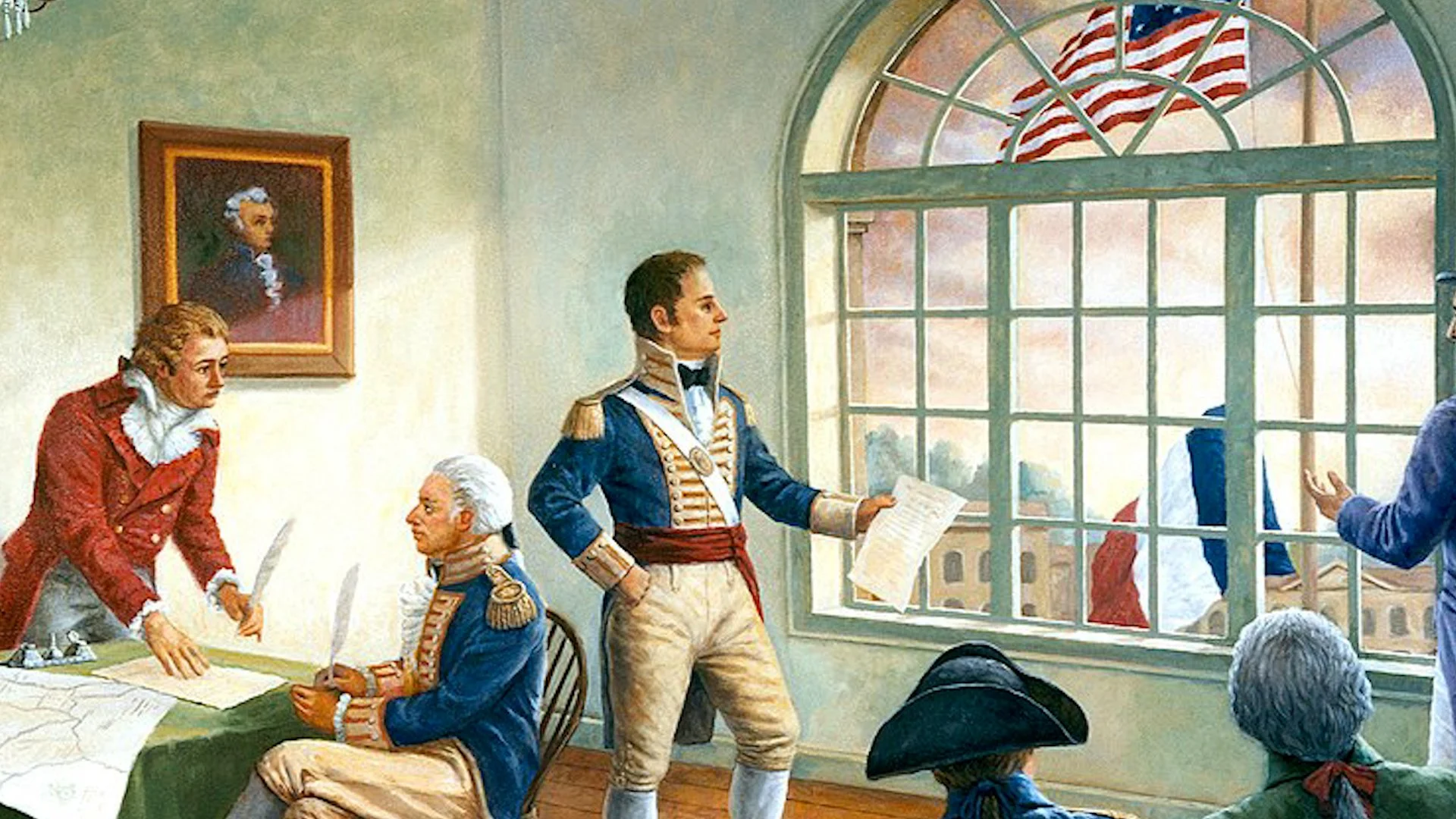
On the day the surrender was to take place, October 19th, Cornwallis claimed to be sick and sent his second in command, General Charles O'Hara, in his place. Rather than surrender to the American rebels, O'Hara tried to hand his sword to Rochambeau, but the Frenchman gestured toward Washington. Washington instructed the reluctant O'Hara to surrender his sword to his own second in command, General Benjamin Lincoln, a Massachusetts farmer who had been injured at the Battle of Saratoga. Lincoln accepted O'Hara's sword, then directed the 8,000 British troops to a nearby field where they laid down their arms and battle flags. America had won the last great battle of the war. Independence won, the new nation faced the harder task of governing itself, the subject of our episode on the Constitutional Convention.