Episode 55 - America's Bloodiest Day
On September 17, 1862, Union and Confederate forces fought along Antietam Creek near Sharpsburg, Maryland, producing the bloodiest single day in American history. This episode covers Lee's invasion of the North, the lost copy of Special Order 191, the fight at the Cornfield and Bloody Lane, Burnside's struggle for the stone bridge, and how Lincoln used the strategic outcome to issue the Emancipation Proclamation just days later.
Key Takeaways
Robert E. Lee invaded Maryland in September 1862 hoping that a Confederate victory on Northern soil would weaken Lincoln politically, threaten Washington, and earn European recognition for the Confederacy.
On September 13, 1862, two Union soldiers near Frederick, Maryland found a copy of Lee's Special Order 191 wrapped around three cigars; the document revealed that Lee had divided his army, but General George B. McClellan waited eighteen hours before acting.
The Battle of Antietam on September 17, 1862 produced roughly 22,000 casualties in a single day, the bloodiest day in American history; major actions unfolded at the Cornfield and Dunker Church, the Sunken Road (Bloody Lane), and Burnside's Bridge.
McClellan repeatedly withheld reserves at critical moments, which prevented a decisive Union breakthrough; A.P. Hill's late-afternoon arrival from Harpers Ferry stabilized the Confederate right and stopped Burnside's advance.
Although tactically inconclusive, Antietam halted Lee's invasion of the North, and Lincoln treated it as the strategic victory he needed to issue the preliminary Emancipation Proclamation five days later, on September 22, 1862.
Sign up here to be the first to know about new History250 releases, content & resources!
Questions & Answers (FAQ):
Q1: Why is Antietam called the bloodiest day in American history?
The Battle of Antietam on September 17, 1862 produced roughly 22,000 casualties (killed, wounded, captured, or missing) in a single twelve-hour day. No other single day of combat on American soil, before or since, has matched that figure. The dead lay so thick across the Cornfield and the Sunken Road that one Union general later wrote, 'The slain lay and rose precisely as they had stood in their ranks a few moments before.'
Q2: What was Special Order 191 and the Lost Order incident?
Special Order 191 was Robert E. Lee's plan, issued on September 9, 1862, to split the Army of Northern Virginia and capture the federal garrison at Harpers Ferry while continuing the Maryland invasion. On September 13, 1862, two Union soldiers in a field near Frederick, Maryland found a copy of the order wrapped around three cigars. The lost document revealed that Lee's army was divided and vulnerable. General George B. McClellan, however, waited eighteen hours before acting, and a pro-Confederate Marylander who had witnessed the discovery rode to warn J.E.B. Stuart, giving Lee time to consolidate at Sharpsburg.
Q3: Why did Robert E. Lee invade Maryland in September 1862?
Lee invaded Maryland for three reasons. First, victories at the Seven Days Battles near Richmond and the Second Battle of Manassas had given him momentum and confidence. Second, fighting on Northern soil promised political damage to Lincoln ahead of the fall congressional elections and could threaten Washington itself. Third, a Confederate win on Union ground might secure formal diplomatic recognition from Britain and France, which would have been transformative for the Southern war effort.
Q4: What was the Cornfield and Bloody Lane at Antietam?
The Cornfield was a 30-acre field of tall corn on the farm of David R. Miller, the site of the morning phase of the battle. Repeated assaults and counterattacks leveled the corn and produced roughly 8,000 to 10,000 casualties by 9 a.m. Bloody Lane, also called the Sunken Road, was a worn farm lane in which Confederate troops under D.H. Hill and Richard H. Anderson formed a natural trench. Union assaults eventually broke the position but suffered terrible losses doing so, and McClellan again declined to commit reserves to exploit the breakthrough.
Q5: How did Antietam lead to the Emancipation Proclamation?
Lincoln had drafted the Emancipation Proclamation by the summer of 1862 but had decided not to issue it from a position of military weakness. Union defeats in the Seven Days Battles and at Second Manassas had left Northern morale low. Antietam, although tactically inconclusive, halted Lee's invasion and forced him back into Virginia. Lincoln treated this as the strategic victory he needed and issued the preliminary Emancipation Proclamation on September 22, 1862, five days after the battle. The final proclamation took effect on January 1, 1863.
Lee Carries the War North
As dawn broke over the rolling hills and open fields of corn near Antietam Creek in western Maryland, it was a clear early fall day, September 17, 1862. Sharpsburg lay nearby, a town of 1,200 farmers and tradesmen. The houses were as modest as the dirt road that formed Main Street. At 5:30 a.m., rifle and cannon fire broke the tranquility of the new day. By dusk, when the smoke had cleared, Antietam had taken its place as the bloodiest day in American history.
Emboldened by his successes at the Seven Days Battles near Richmond and the Second Battle of Manassas near Leesburg, Confederate Army commander Robert E. Lee moved his forces into Maryland. The stakes were high. For the first time, Lee and his troops had brought the war into the North. Confederate victories in Union territory could lead to the fall of Washington. As national elections approached, Southern advancements would likely undermine Lincoln's efforts to hold on to Congress. And if Lee could win in the North as he did in Virginia, the Confederacy just might win the recognition of European nations.
Special Order 191 and the Lost Order
Lee needed a supply line through the Shenandoah Valley. The Union garrison at Harpers Ferry stood in the way. On September 9, while encamped at South Mountain near Frederick, Maryland, Lee issued Special Order 191, a bold plan that involved splitting his army. James Longstreet would continue west into Maryland as D.H. Hill covered the gaps in South Mountain, preventing the Union army from following Longstreet. Stonewall Jackson's wing would march to Martinsburg, capture a small federal garrison there, and take Harpers Ferry. Once these objectives were accomplished, the Confederates would reunite in Maryland. On September 12, Jackson, with the help of A.P. Hill, Lafayette McLaws, and John G. Walker, besieged Harpers Ferry.
On September 13, however, in a field near Frederick, two Union soldiers stumbled onto a copy of Lee's orders. The document was wrapped around three cigars. McClellan now realized that the Confederate army was divided and vulnerable, but eighteen hours elapsed before he acted. That night, a pro-Confederate Marylander who had witnessed McClellan's discovery of Lee's plans rode hard to General J.E.B. Stuart, commander of the Confederate cavalry. He in turn informed the Confederate commander. Reinforced by Longstreet, D.H. Hill and his forces defended the gaps at South Mountain until nightfall. They had bought Lee a day.
The Cornfield and the Dunker Church
Now the commander, who had won two major campaigns in the previous months, had two choices: withdraw before McClellan could strike while his army was still divided, or position himself to fight. Lee withdrew west to Sharpsburg, Maryland to take another stand in his attempt to strike a blow on Northern soil. On September 15, Jackson and the Confederate forces captured Harpers Ferry. On September 16, most of them arrived in Sharpsburg. A.P. Hill had stayed behind to collect armaments from the federal garrison. At approximately 5:30 in the morning of September 17, Union General Joseph Hooker attacked first. The opposing forces clashed at Miller's Cornfield and the Dunker Church. Initially, the tall corn created confusion. By morning's end, the field had been leveled by weapon fire. The now-open field provided no cover.
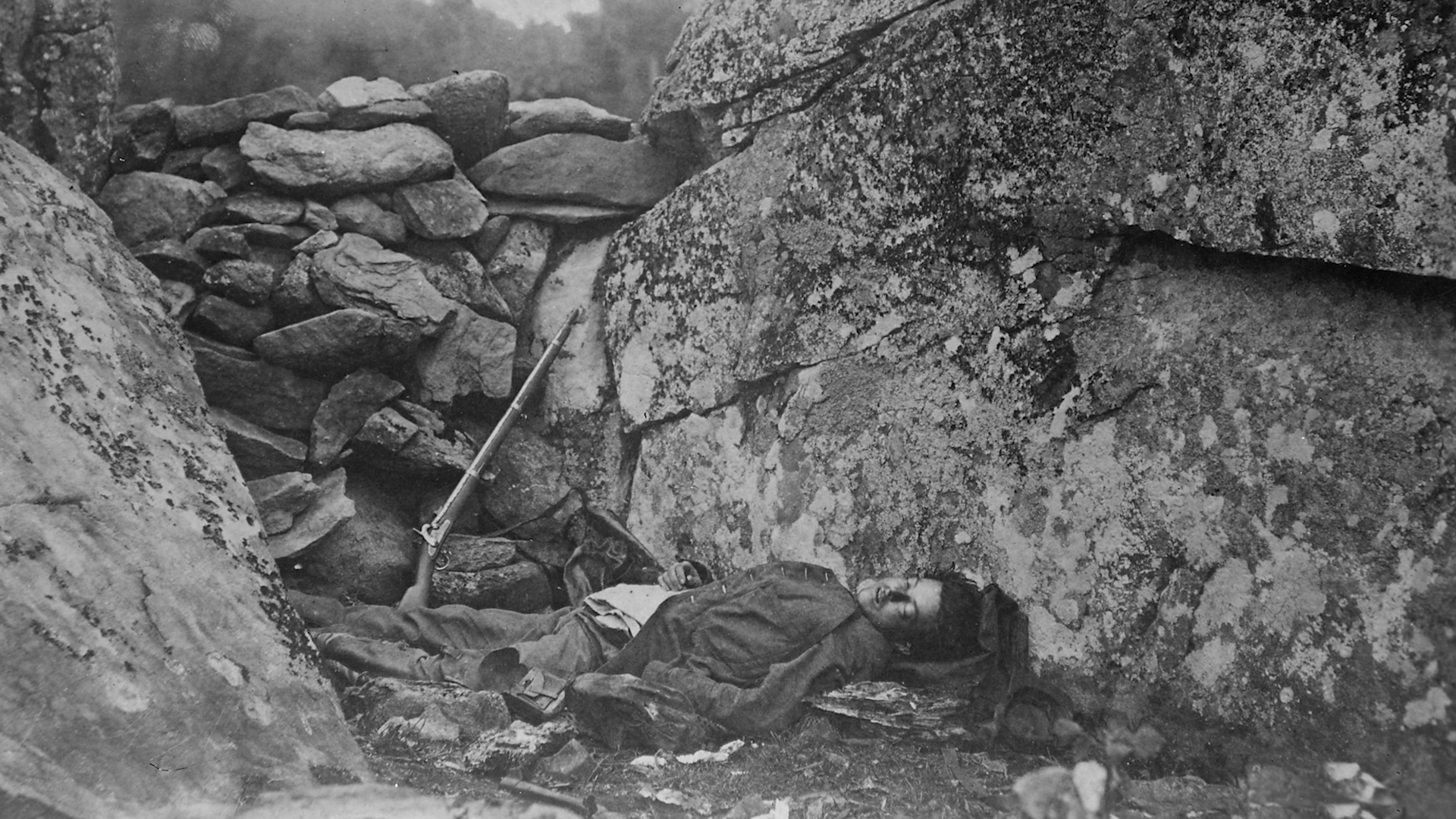
Massive volleys and repeated attacks took a terrible human toll, somewhere between 8,000 and 10,000 casualties by 9:00 a.m. Hooker recounted later, 'The slain lay and rose precisely as they had stood in their ranks a few moments before.' Despite the Union's advantage in numbers of troops, and because McClellan withheld reserves that would have kept the advantage, Stonewall Jackson and his forces held their ground so that no major breakthrough occurred.
Bloody Lane and Burnside's Bridge
The battle shifted to the Sunken Road, also known as Bloody Lane. General Edwin Sumner led an attack on the Confederate center. Under the leadership of Generals D.H. Hill and Richard H. Anderson, the rebels used the Sunken Road as a natural trench. Union forces pierced the center, but the advantage was only temporary. Again, McClellan withheld reserves, and again, the federal troops withdrew. Major General Ambrose Burnside led the IX Corps in a final assault that lasted from 1:00 to 5:30 p.m.
Their objective was to cross Antietam Creek by way of a narrow stone bridge and attack the Confederate right flank. After hours of delay, the Union forces took the bridge and threatened a Confederate retreat. In the late afternoon, having marched all the way from Harpers Ferry that day, A.P. Hill and his men reinforced the Confederate line. The Union advance halted. As the sun set, the battle faded out. With over 22,000 casualties, doctors were overwhelmed. Clara Barton arrived with crucial supplies on the Union side. The future founder of the American Red Cross was known as the 'angel of the battlefield.'
The Door to Emancipation
Lee and McClellan skirmished some on September 18. Late that night and into the next day, Lee withdrew from Antietam and slipped back across the Potomac into Virginia. The battle ended inconclusively. But because Lee's advance was halted, Lincoln considered it a strategic victory. Just a few days later, that interpretation helped Lincoln issue the Emancipation Proclamation.